Probation officers threaten work-to-rule over early release crisis
Plan to release thousands of criminals, including Pc Harper’s killers, leaves staff facing ‘major headache’
Probation officers have threatened to protest against the early release of prisoners by working to rule and refusing overtime.
Napo, the probation union, warned that Andy Burnham’s plan to release 5,000 offenders risked creating “a major headache” for staff, who it said were already overworked and underpaid.
The Prime Minister paused the early release scheme last month after The Telegraph revealed that Albert Bowers and Jessie Cole, two of Pc Andrew Harper’s killers, would be eligible to leave prison after serving half their sentences.
While Mr Burnham has exempted rapists and child sex offenders, Bowers and Cole remain eligible for release alongside thousands of other prisoners.
The probation watchdog has already warned that officers may be inadequately prepared for the early releases, increasing the prospect of freed prisoners committing further crimes.
Ian Lawrence, the general secretary of Napo, said prison officers could respond by refusing to carry out extra duties outside their core working hours and competencies.
He told the BBC’s Today programme: “We don’t have enough resources, and £700m per year over the next three years is welcome, but I want to see some of that put into the frontline provision. Our members’ workload is through the roof and pay is totally inadequate for the responsibility of the job.
“And we need an agreement with this Government pretty quickly, unless we can move to a place where we can avoid the possibility of industrial action – it’s that serious, it’s that desperate out there for our members.”
Ministers have said that the £700m investment in the Probation Service by 2028 will lead to the biggest expansion of electronic tagging in history. Offenders will also face strict licence conditions, closer supervision, exclusion zones and curfews.
Asked what industrial action could involve and how soon it could come about, Mr Lawrence said there were various forms of action available to employees.
“[One] would be working to our contracted hours,” he said. “The amount of free time that probation officers give to make ends meet in managing risk and helping to protect the public is huge.
“And whole swathes of paid overtime are being undertaken, without which the whole system would collapse. I don’t want that to happen – I want an agreement with government.”
Mr Lawrence also took a swipe at Mr Burnham for including domestic violence and stalking offenders in the early release scheme, saying they were more likely to reoffend and be recalled to prison.
“We need the resources in place to help victims, to reassure victims that we’re doing our best,” he added.
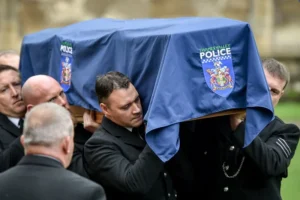
Pc Harper was investigating the theft of a quad bike in Berkshire in August 2019 when Bowers and Cole tried to escape in a car driven by Henry Long.
The 28-year-old policeman died after his ankles were caught in a towrope loop and he was dragged for more than a mile along country roads. All three were convicted of manslaughter. Long was jailed for 16 years, and Bowers and Cole were jailed for 13.
On Friday, the detective who led the investigation into the death of Pc Harper said he was “appalled” that Bowers and Cole could be released early.
Stuart Blaik, a former detective superintendent with Thames Valley Police, urged Mr Burnham to ensure that they served their full sentences.
He told the BBC he was “deeply concerned and appalled” that they could walk free under the early release scheme, saying they “should not be afforded the opportunity”.
Mr Blaik told the BBC: “Neither of them showed any remorse during their time in police custody or during their subsequent trial. I hope the Government takes account of the strength of public feeling on this issue, which has been both clear and widespread.”
Speaking before Pc Harper’s killers were sentenced in July 2020, Mr Blaik said they had taken a “conscious decision” not to assist police, and accused their families and friends of frustrating the investigation.
Pc Harper’s mother and widow have condemned the decision not to exempt manslaughter from the early release scheme, and said the prospect of Bowers and Cole being freed as soon as October was an “affront to justice”.
The Government has apologised to Pc Harper’s family, but has sought to justify its refusal to make an exemption.
Jake Richards, a justice minister, said this week that ministers could not “hand-pick cases for different criminal justice consequences”.
Rejecting calls for prisoners who killed emergency service workers to be made ineligible for early release, Mr Richards said: “There are groups of offenders, and we have to deal with them as groups of offenders. I understand that’s difficult, I understand that’s uncomfortable, but that is the way to have a functioning government.”
The Tories have said they will attempt to block the early release of Pc Harper’s killers in a parliamentary vote when MPs return from their summer break next month.
Kemi Badenoch’s party is preparing an amendment to Labour’s Sentencing Act 2026 that would exclude criminals convicted of the manslaughter of an emergency worker from the early release scheme.
MPs would vote on the proposal if Sir Lindsay Hoyle, the Commons Speaker, selected it. The vote would be the first big parliamentary test for Mr Burnham since he took power last month.
The Government could also face legal action from the Police Federation, which represents rank-and-file officers. Chief Constable Jason Hogg, of Thames Valley Police, has indicated that he would support any legal challenge.
Matthew Barber, the police and crime commissioner for Thames Valley, has accused Mr Burnham of ignoring a letter from the police chief urging him to keep Bowers and Cole in jail.
Sir Mark Rowley, the Metropolitan Police commissioner, said on Thursday that he supported everything Mr Hogg had said about the potential early release of the two men.
He added: “Police officers see it as a message of a lack of support from the justice system, and I don’t think that’s good.
“I think it’s good that, from what I’ve heard, the Prime Minister is reflecting on the current policies about [the] justice system and things. They inherited a very difficult situation. I don’t think he’s got easy decisions.
“I don’t want to pretend this is easy, but I think we’re in a dangerous place if the justice system is tipping towards making more decisions based on the resources available than based on the risk that offenders pose to communities.”