A Moment of Light to Close the Year: Stephen Colbert’s Family Brings New Year Warmth to Late Night
A Moment of Light to Close the Year: Stephen Colbert’s Family Brings New Year Warmth to Late Night
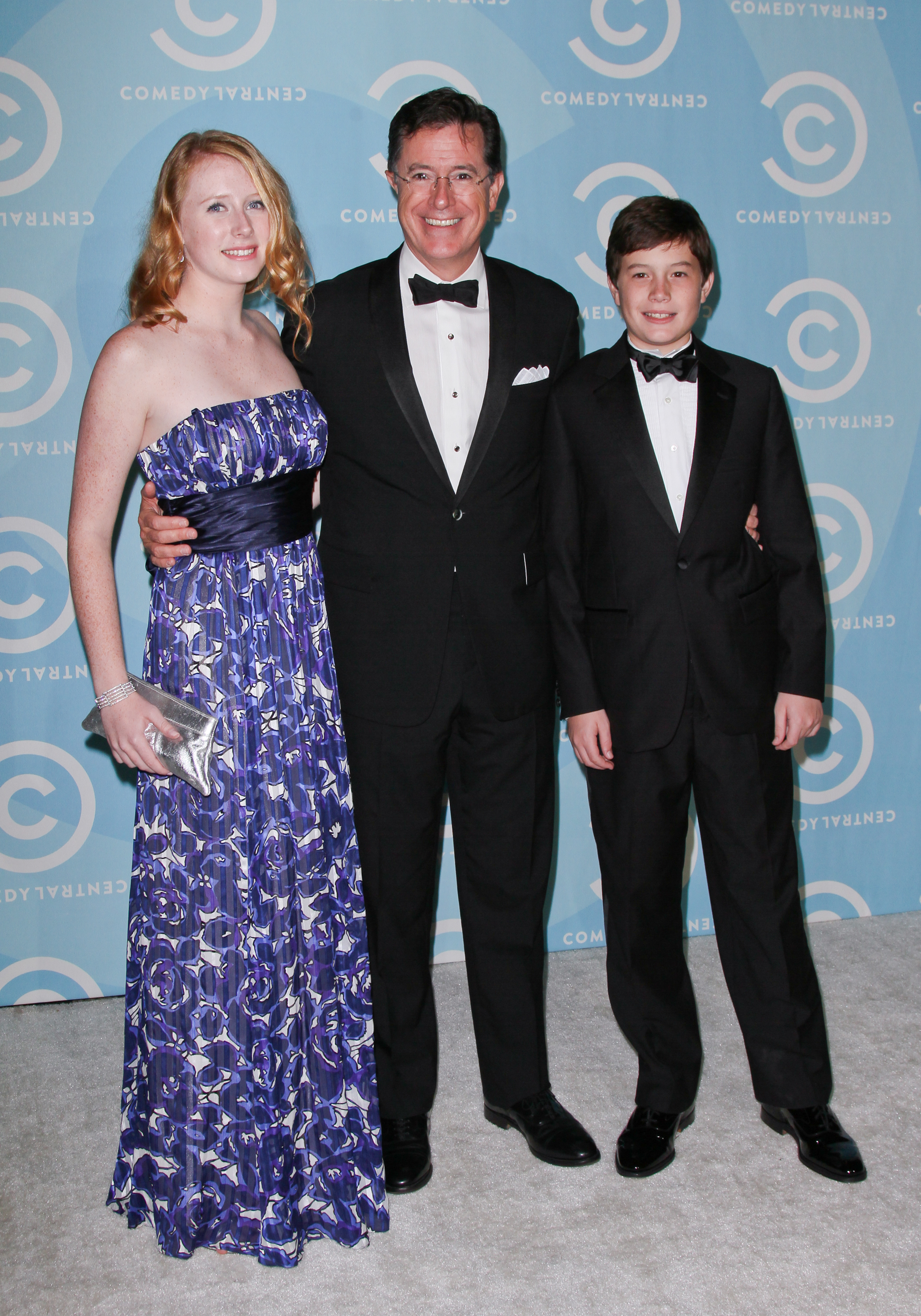
As the final days of the year unfolded and a turbulent news cycle showed little sign of slowing,
The Late Show offered viewers something rare and quietly powerful: a moment of uncomplicated warmth.
During a special New Year segment, Stephen Colbert stepped onto the late-night stage not as a satirist, not as a political commentator, but as a husband and father. Joining him were his wife, Evelyn McGee-Colbert, and their children, appearing together to share a simple New Year message that resonated far beyond the studio.
There were no jokes sharpened for headlines.
No monologues aimed at controversy.
No punchlines designed to go viral.
Instead, there was family.
A Different Kind of Late-Night Moment
Late-night television is built on routine. Viewers expect a familiar rhythm: topical humor, celebrity interviews, music, and a closing joke before the credits roll. Family appearances — especially involving children — are rare, carefully guarded, and usually brief.
That made this segment stand out immediately.
The set lighting softened. The usual desk was pushed aside. Colbert stood center stage with his family beside him, the mood unmistakably different from the sharp-edged satire that often defines the show.
“As we step into 2026,” Colbert said, smiling, “we wish everyone peace, joy, and a little more hope.”
It was not a line written to trend.
It was a sentiment meant to land gently.
Evelyn McGee-Colbert’s Quiet Presence
Evelyn McGee-Colbert, who has largely remained out of the spotlight despite her husband’s prominence, added a brief message of her own. Her words focused on comfort, togetherness, and the importance of showing up for one another — especially after years that have tested families, communities, and institutions alike.
Her presence grounded the moment.
Where Colbert’s public persona is animated and expressive, Evelyn’s calm delivery reinforced the sincerity of the segment. The balance felt intentional: humor giving way to humanity.
A Message for the Next Generation
Perhaps the most striking part of the segment came when Colbert’s children addressed the audience.
Their message was short, unpolished, and unmistakably genuine: encouragement for young viewers to stay kind, to keep dreaming, and to believe in the value of empathy even when the world feels loud or divided.
There was no attempt to script them into miniature performers. Their words landed precisely because they felt unscripted — the kind of advice passed down at a family table rather than broadcast from a studio.
For many viewers, that authenticity was the emotional center of the segment.
Why the Moment Resonated
Within hours, clips of the segment began circulating online. Unlike many viral moments driven by outrage or shock, this one spread for a different reason.
People were relieved.
In an era where public figures are often expected to perform constantly — to react, to comment, to take sides — Colbert’s choice to pause and share a personal, non-political message felt restorative.
Fans praised the segment as “grounding,” “unexpectedly emotional,” and “a reminder of what actually matters.”
Media critics noted that the moment worked precisely because it resisted spectacle. There was no attempt to rebrand, no hidden messaging, no agenda beyond offering goodwill.

Colbert Beyond the Desk
Stephen Colbert has built a career on sharp intellect and fearless satire. His monologues often dissect power, hypocrisy, and cultural absurdity with surgical precision. But moments like this reveal another dimension of his public presence — one that viewers see less often, but recognize immediately.
Throughout his career, Colbert has spoken openly about faith, family, and loss, often in quieter interviews rather than on air. This New Year segment felt like a natural extension of that worldview: a belief that humor and seriousness can coexist, and that hope does not need to be ironic to be meaningful.
“Happy New Year — from our family to yours,” Colbert said as the segment closed.
The line was simple.
And that was enough.
A Contrast to the Cultural Noise
The timing of the segment mattered.
As 2025 gave way to 2026, audiences were exhausted by polarization, algorithm-driven outrage, and a sense that public discourse rarely slowed down long enough to breathe. Against that backdrop, the Colbert family’s message functioned almost as a reset — a reminder that not every broadcast moment has to escalate tension.
Sometimes, the most memorable television moments are the quiet ones.
Industry Reaction
Within the entertainment industry, the segment was viewed as a thoughtful departure from late-night convention. Producers and commentators noted how effectively it reinforced Colbert’s credibility — not as a pundit, but as a person viewers trust.
Trust, after all, is built not only through critique, but through consistency of values.
By sharing his family on screen without turning them into a spectacle, Colbert reinforced a boundary many viewers appreciate: that public life does not have to consume private life, and that when those worlds intersect, it can be done with care.
Why It Will Be Remembered
Years from now, the segment is unlikely to be remembered for ratings or headlines. It will be remembered for tone.
It captured something rare in modern media: sincerity without performance, optimism without denial, and warmth without pretense.
At a time when audiences often feel spoken at, the Colbert family spoke with them.
Closing the Year with Light
As the show returned to its usual format and the credits rolled, the moment lingered — not because it demanded attention, but because it offered comfort.
In the end, Stephen Colbert did not close the year with a joke, a jab, or a provocation.
He closed it the way many families hope to begin the next one:
together, grateful, and quietly hopeful.
And for a few minutes on late-night television, that was more than enough.