Madame Bovary: A Restrained, Visually Striking Take on Flaubert’s Tragic Heroine

Sophie Barthes approaches one of literature’s most difficult heroines with an unusually controlled hand. Rather than turning Emma Bovary’s story into a sweeping romantic tragedy, the director creates a deliberately restrained portrait of a woman suffocating under the limitations of provincial life — and desperately searching for something that might make her feel alive.
The 2014 adaptation of Gustave Flaubert’s 1856 novel stars Mia Wasikowska as Emma, with Henry Lloyd-Hughes, Rhys Ifans, Ezra Miller, Logan Marshall-Green and Paul Giamatti in supporting roles. Barthes co-wrote the screenplay with Felipe Marino, while Andrij Parekh handled the cinematography. The film premiered at the Telluride Film Festival on August 30, 2014, before later reaching U.S. theaters in June 2015.
A familiar tragedy told from the inside

Flaubert’s story has been adapted for film and television many times, including Vincente Minnelli’s 1949 version and Claude Chabrol’s 1991 adaptation starring Isabelle Huppert. Barthes’ version distinguishes itself by placing Emma’s emotional experience firmly at the center.
The film was also notable for being presented as the first adaptation of the novel directed by a woman — an especially interesting distinction given Emma’s status as one of literature’s most recognizable female characters.
Rather than relying heavily on narration or interior monologue to explain Emma’s thoughts, Barthes allows the character’s emotions to emerge through faces, pauses, gestures and surroundings.
That makes the film feel less like an explanation of Emma and more like an observation of her.
The result is slow-burning and atmospheric. It may not always generate the urgency of the novel, but it creates a convincing sense of confinement, with the visual environment constantly reflecting Emma’s growing dissatisfaction.
Emma Bovary wants more — but what exactly?
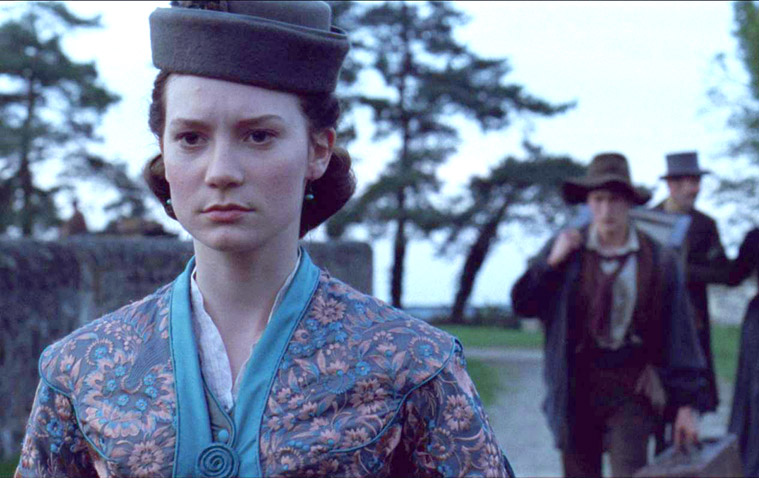
The story begins near its tragic conclusion.
Emma is seen racing through the countryside with a bottle of poison in her hand. From there, the narrative moves backward, returning to the beginning of her marriage and gradually revealing the choices that brought her to that desperate moment.
Emma’s early life has been shaped by the rituals and restrictions of a convent education. She eventually marries Charles Bovary, a provincial doctor played by Henry Lloyd-Hughes.
Charles is kind, dependable and deeply ordinary.
For Emma, that becomes the problem.
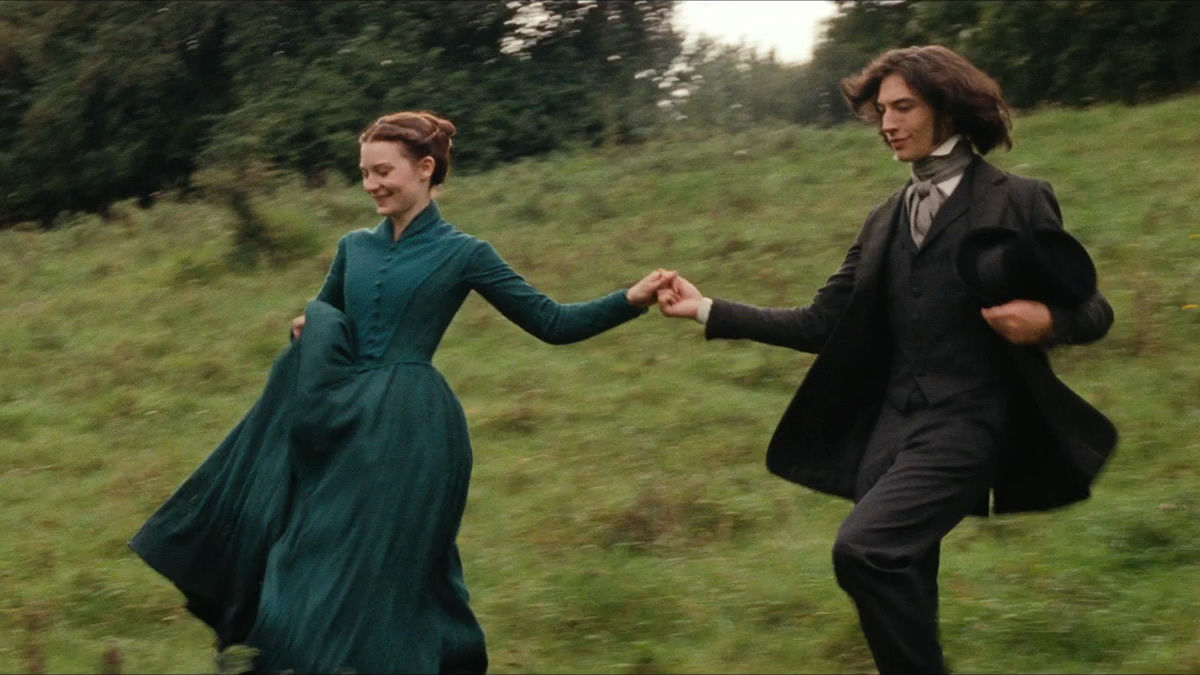
Settled in the small town of Yonville, she finds herself surrounded by plain rooms, an unremarkable garden and a husband who lacks the ambition and imagination she craves. Her dissatisfaction is not simply with Charles but with the entire existence that has been laid out before her.
Barthes repeatedly holds the camera on Wasikowska’s face as Emma studies her surroundings. The silence becomes part of the storytelling: she is physically present in her new life but increasingly unable to accept it emotionally.
From temptation to obsession

At first, Emma tries to resist the opportunities that appear to offer escape.
One comes through Monsieur Lheureux, played by Rhys Ifans, a persuasive merchant who introduces her to beautiful fabrics, decorative objects and the pleasures of consumption.
Another is Leon, a young law student played by Ezra Miller. Leon develops feelings for Emma, but she initially refuses to act on them. He eventually leaves for Rouen to continue his studies, and the city becomes almost mythical in Emma’s imagination — a place representing culture, sophistication and the life she believes she is missing.
Then comes the Marquis d’Andervilliers, played by Logan Marshall-Green.
Unlike Leon, he is worldly and confident, and Emma eventually gives in to the attraction. What begins cautiously develops into a pattern of increasingly desperate attempts to find fulfillment.
The film strips away some of the novel’s broader narrative material to concentrate more tightly on Emma’s emotional trajectory. Among the changes is the removal of the pregnancy and child-related storyline, keeping the focus largely on Emma’s dissatisfaction and relationships.
Mia Wasikowska’s greatest strength is her distance
Mia Wasikowska is an intriguing choice for Emma precisely because she does not make the character particularly easy to love.
Her performance is built around dissatisfaction. Emma rarely seems content, and even when she gets what she wants, the pleasure is fleeting.
That quality becomes particularly effective in scenes involving Charles.
When he agrees to attempt a potentially career-changing operation on Hippolyte (Luke Tittensor), a young man with a clubfoot, Emma briefly allows herself to believe that Charles might finally become the ambitious man she wants him to be. Her optimism quickly collapses when the operation goes disastrously wrong.
Wasikowska communicates that reversal largely through her expression: hope gives way to disappointment, then disgust.
It is an approach that fits Barthes’ preference for visual storytelling. Rather than constantly telling viewers what Emma is thinking, the film asks them to study her.
Emma isn’t simply searching for another man
The most interesting interpretation of Emma is that her lovers are not really the destination.
Leon and the Marquis may represent different versions of escape, but neither truly satisfies her. Even the luxury she acquires through Lheureux ultimately fails to provide the happiness she imagines it will bring.
Emma’s deeper obsession is with the feeling of wanting something.
She is addicted to possibility itself — to the idea that somewhere, somehow, there must be another life waiting for her.
That makes her tragedy more complicated than a simple story about an unhappy marriage. Emma wants to break beyond the rigid moral and social boundaries of her world, but she has no clear idea of what freedom would actually look like once she reaches it.
The film wisely avoids turning her into either a pure victim or a romantic rebel. She can be selfish, impulsive and destructive, yet her frustration is also understandable.
A beautiful world that feels increasingly suffocating
The visual design is one of the film’s greatest strengths.
Andrij Parekh’s 35mm cinematography uses natural light and carefully composed images to create a world that is both beautiful and oppressive. Candlelight, windows, muted interiors and the surrounding countryside all contribute to the sense that Emma is trapped inside an existence that looks picturesque from the outside but feels suffocating from within.
The production design by Benoît Barouh moves between sparse provincial interiors and more extravagant settings, while Valérie Ranchoux’s costumes give Emma increasingly elaborate dresses as her appetite for a more luxurious existence grows.
The contrast is deliberate.
The more Emma tries to transform her surroundings, the more apparent it becomes that changing the wallpaper cannot solve what is wrong inside her.
The hunting sequence and the shadow of tragedy
One of the film’s most striking sequences is a hunting party organized by the Marquis.
Barthes uses the landscape, natural imagery and the piano-centered score by Evgueni and Sacha Galperine to create an increasingly ominous atmosphere. The sequence carries a strong sense of foreboding, as though Emma’s pursuit of pleasure has already begun to acquire an unavoidable cost.
The symbolism is not subtle, but it is effective.
Throughout the film, nature and weather frequently reinforce Emma’s emotional state, while the increasingly oppressive imagery suggests that the outcome revealed at the beginning is drawing closer.
A deliberate break from Flaubert’s realism
One of the more unusual decisions is the film’s use of English dialogue delivered in the actors’ natural accents.
That choice creates a noticeable distance from the rigorous realism associated with Flaubert’s original work. Paul Giamatti’s performance as pharmacist Monsieur Homais is particularly distinctive, although his character is less developed than some of the others.
Yet almost everything surrounding the performances works hard to establish the period.
The production design, costumes and cinematography create a persuasive 19th-century environment, with Parekh’s camera alternating between formal compositions and controlled handheld movement. The extensive use of natural light gives even the most carefully staged scenes a grounded quality.
A classic that remains difficult to capture
The challenge facing any adaptation of Madame Bovary is enormous. Flaubert’s novel is built around Emma’s inner life, and translating that interiority into visual storytelling without simply explaining everything to the audience is no easy task.
Barthes does not completely overcome that difficulty.
The film can feel emotionally distant, particularly when its slow pace and deliberately bleak atmosphere begin to overwhelm the drama. Other critics similarly found the adaptation visually accomplished but lacking some of the emotional force required to make Emma’s downfall fully gripping.
Still, the restraint is also part of what makes this version distinctive.
Rather than asking viewers to admire Emma, pity her or condemn her, Barthes leaves enough ambiguity for all three reactions to coexist.
The result is a carefully crafted period drama that understands the darkness at the heart of Flaubert’s story: Emma does not simply want love, wealth or another man.
She wants a life that feels larger than the one she has been given.
And the tragedy is that every attempt to escape it only carries her closer to the ending we already know is waiting for her.
The film runs 118 minutes and features Mia Wasikowska, Rhys Ifans, Ezra Miller, Logan Marshall-Green, Henry Lloyd-Hughes, Laura Carmichael, Olivier Gourmet, Paul Giamatti and Luke Tittensor.