Stephen Frears reunited with screenwriter Christopher Hampton for Chéri, their second adaptation of a celebrated French literary work after the pair’s acclaimed 1988 version of Choderlos de Laclos’s Dangerous Liaisons. This time, they turned to Colette’s 1920 novel, another work that challenged the conventions of its era.
Set against the refined world of Paris during the belle époque, before the First World War, the film centers on Léa, a former courtesan who is still beautiful and sophisticated despite being middle-aged. The role is played by Michelle Pfeiffer, who previously appeared in Dangerous Liaisons as the young woman caught in the schemes of a cynical aristocratic society.
In Chéri, Pfeiffer’s character occupies a very different position. Léa becomes involved with Fred, a handsome, self-absorbed 19-year-old whom she affectionately calls Chéri. Their relationship develops over six years, creating an unusual emotional bond between the experienced older woman and her much younger lover.
A Romance Complicated by Marriage

Chéri is the illegitimate son of a wealthy former lover of Madame Peloux, another retired courtesan played by Kathy Bates.
Madame Peloux ultimately interferes with Léa and Chéri’s long relationship. She arranges for her son to marry an attractive 18-year-old woman who is herself the daughter of another woman from the demi-monde.
That decision becomes the central emotional conflict of the story.
For Léa, the marriage means losing the young man who has been her lover for years. For Chéri, meanwhile, marriage forces him to confront the emptiness of a relationship that does not possess the emotional depth of what he had with Léa.
The basic plot is relatively simple, but Colette’s novel was never primarily driven by elaborate twists. Its real power lies in the subtle emotions beneath the polished surface of Parisian high society—the conflicting desires, attachments and disappointments that the characters rarely express openly.
A World That Refuses to Apologize
One of the film’s more distinctive qualities is its refusal to impose conventional moral judgments on the characters or their relationships.
The sexual relationship between a much younger man and an older woman has traditionally been an uncomfortable subject in Anglo-Saxon culture, with The Graduate offering another well-known example of the tension surrounding such relationships.
Frears addresses that discomfort immediately. An anonymous voice-over narrator, voiced by Frears himself, begins the film by explaining the social role of the courtesan and the world in which these women lived.
After that introduction, the film largely leaves its characters to speak and act for themselves. There is little attempt to excuse or condemn their behavior.
Frears and Hampton instead observe this society with a style that has a distinctly verbal, almost sub-Wildean quality while remaining notably non-judgmental.
Yet the film ultimately reaches far beyond the events depicted on screen. Near the conclusion, the narrator jumps forward in time and reads the final lines from Colette’s sequel, The Last of Chéri. Those lines calmly describe Chéri’s suicide after the Second World War, giving the story a much darker final perspective.
Beautiful to Look At, More Difficult to Feel
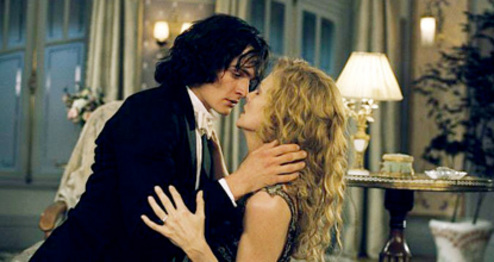
The performances are solid, and the film has an undeniably sumptuous visual quality. Its period setting and elegant Parisian world are presented with considerable beauty.
But the emotional intensity that should drive the story does not always come through with equal force.
Much of the film’s underlying erotic and emotional turbulence is carried by Alexandre Desplat’s persistent musical score. The music supplies a sense of passion and unease that the drama itself sometimes struggles to sustain.
That leaves Chéri in an unusual position. It possesses an intriguing literary foundation, a striking setting, strong performers and a visually ravishing presentation. Yet beneath that polished surface, the film can feel strangely detached—beautiful and carefully observed, but curiously blank at its emotional core.