What began as a lighthearted championship celebration for New York Knicks fans has rapidly evolved into one of the strangest viral scandals of the year, ending with the downfall of a high-ranking corporate executive and leaving thousands of people asking the same question: what was she thinking?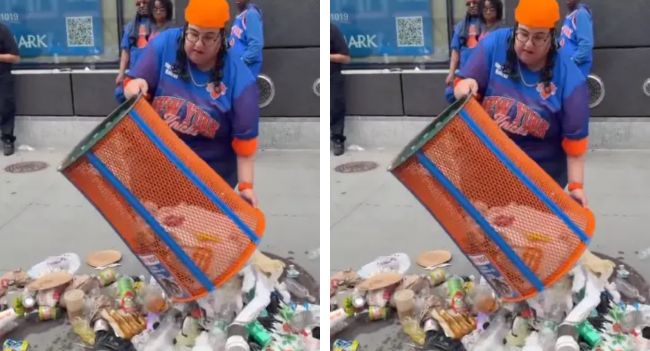
The controversy erupted after a video circulating across social media appeared to show Angie Báez, a former executive at JPMorgan Chase, dumping the contents of a Knicks-themed public trash can onto a Manhattan street before allegedly taking the bin and walking away with it. Within hours, the footage had spread across the internet, transforming an otherwise ordinary parade incident into a national conversation about public behavior, corporate accountability and the consequences of viral fame.
At first glance, the episode seemed almost absurd.
The championship parade had drawn enormous crowds celebrating the Knicks’ historic title run, and social media was already flooded with videos of emotional fans, chaotic street scenes and over-the-top celebrations. Yet among countless clips from the festivities, one video stood out. Witnesses watched as a woman emptied trash onto the pavement, lifted the specially branded receptacle and appeared to carry it away as if it were a prized souvenir rather than public property.
What made the story explode even further was the identity of the woman at the center of the controversy.
Báez was not an anonymous fan caught making a bad decision in the heat of the moment. Reports identified her as a senior executive whose career included leadership roles focused on community engagement and diversity initiatives at major companies. Her professional background had been built around public-facing leadership, making the contrast between her corporate image and the viral footage impossible for many observers to ignore.
As outrage mounted online, pressure quickly shifted toward JPMorgan Chase.
The banking giant soon confirmed that Báez was no longer employed by the company. While the firm emphasized that she attended the parade in a personal capacity and was not representing the organization, the separation fueled speculation that the viral incident had become impossible to ignore inside corporate circles.
The fallout was swift and unforgiving.
What might once have been dismissed as a bizarre local story suddenly became a cautionary tale about the power of social media. Years of professional accomplishments were eclipsed almost overnight by a video lasting only a few seconds. Online commentators debated whether the punishment fit the offense, while others argued that public conduct inevitably reflects on individuals occupying prominent leadership positions.
Meanwhile, city officials expressed frustration over the destruction of public property and the litter left behind. The Knicks-themed trash cans had been installed as part of the city’s celebration efforts, turning what should have been a symbol of civic pride into the centerpiece of an embarrassing controversy.
Yet amid the outrage, one mystery continues to linger.
Why that particular trash can?
Some observers have suggested the specially designed Knicks receptacles may have become unexpected collector’s items during the championship celebrations, motivating fans to grab anything connected to the historic victory. Others believe the explanation may be far more mundane and impulsive. But because Báez has not publicly offered a detailed explanation of her actions, the internet has been left to fill the silence with theories.
And according to people who attended the parade, there may be details from the moments before the video began recording that have never been fully explained. Witnesses have hinted that the viral clip may not tell the entire story, though no additional context has emerged publicly.
For now, the stolen trash can has become far more than a piece of street furniture. It is the unlikely symbol of a viral scandal that cost an executive her career—and a mystery that, despite millions of views, still lacks one crucial piece of information: the reason it happened in the first place.