The Whisper Man Review: Robert De Niro and Adam Scott Enter a Rain-Soaked Serial-Killer Mystery That Struggles to Escape Familiar Territory
With Robert De Niro, Adam Scott, Michelle Monaghan and Michael Keaton sharing the screen in a dark serial-killer thriller, The Whisper Man arrives with the kind of cast that immediately raises expectations.
The ingredients are equally promising: a grieving father and son, an unsettling old house, a missing child, a retired detective haunted by a notorious murder case and disturbing signs that a killer from the past may not be finished after all.
Adapted from Alex North’s bestselling novel and directed by The Rule of Jenny Pen filmmaker James Ashcroft, the Netflix thriller embraces virtually every atmospheric element associated with the genre.
Rain falls relentlessly. Houses remain inexplicably dark. Detectives chase disturbing clues through gloomy locations. A killer lurks just outside the frame. And an imprisoned murderer may hold the answer to stopping another crime.
The result is undeniably moody and occasionally unsettling. Yet despite an impressive cast and a premise designed to generate dread, the film struggles to transform those familiar ingredients into something genuinely distinctive.
A Father and Son Arrive in a House Filled With Unease
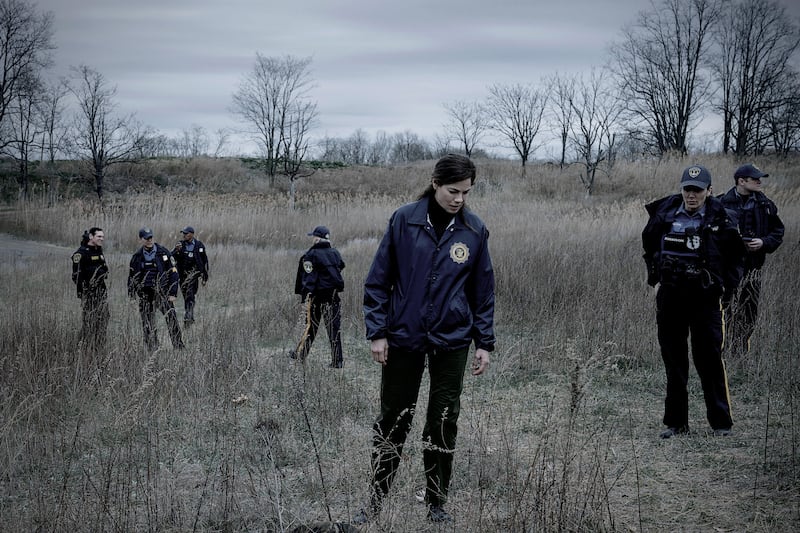
At the center of the story is Tom Kennedy, played by Adam Scott.
Tom is a writer attempting to rebuild his life after the death of his wife. Hoping for a fresh start, he moves with his young son Jake, played by Acston Luca Porto, to the quiet New Jersey hometown of Jake’s late mother.
Their new home hardly feels comforting.
It is an enormous, old-fashioned mansion filled with dark wood, sweeping staircases and shadowy rooms — the sort of house that immediately announces itself as a perfect setting for something sinister.
Tom and Jake are already struggling with grief before anything unusual happens.
Jake remains deeply affected by his mother’s death and has become withdrawn. He also speaks to an imaginary friend, a mysterious girl wearing a blue sweater.
Tom, meanwhile, is trying to manage his own grief while maintaining a relationship with a son he cannot always understand.
Then the house begins giving them reasons to be genuinely afraid.
Strange Things Begin Happening Almost Immediately
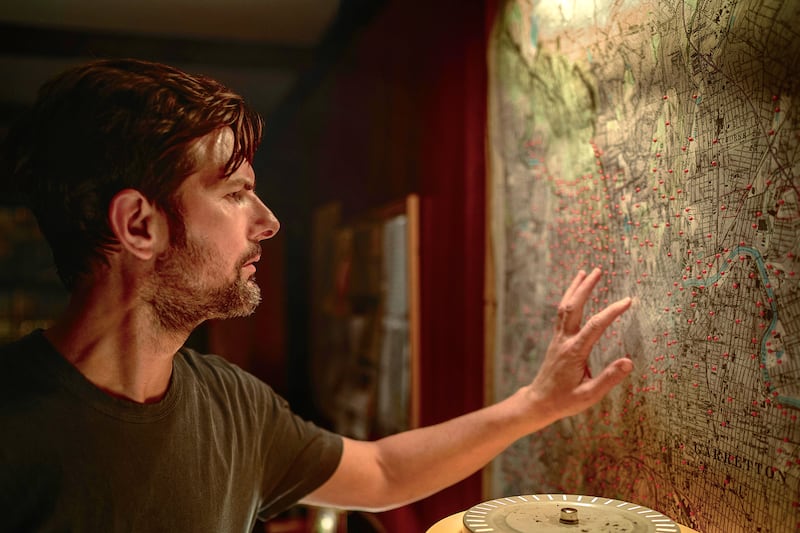
The unsettling incidents arrive quickly.
Tom discovers someone hiding in the basement.
Jake hears strange sounds outside his bedroom window.
Then Tom encounters something far more disturbing: a gloved hand reaching through the mail slot in the front door.
These moments establish an atmosphere somewhere between psychological thriller and supernatural horror.
Is someone watching the family?
Is Jake imagining more than Tom realizes?
Or has their arrival somehow connected them to something much darker?
The film keeps those possibilities hovering over the story while introducing another investigation unfolding nearby.
Michelle Monaghan’s Detective Discovers a Disturbing Connection
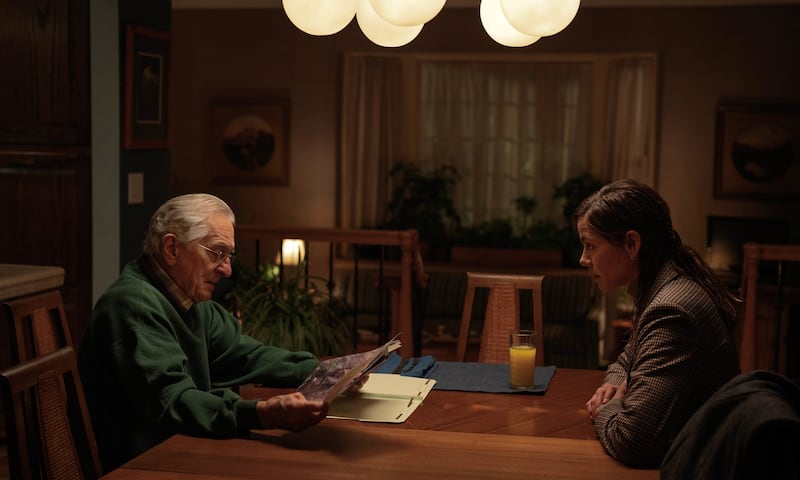
Detective Amanda Beck, played by Michelle Monaghan, is investigating the disappearance of a boy named Neil Spencer.
The case becomes considerably more disturbing when another young victim is discovered.
Amanda immediately recognizes details associated with one of the area’s most infamous murderers: the Whisper Man.
The original killer was identified as Frank Carter and captured years earlier by Detective Peter Willis, played by Robert De Niro.
Peter has since retired.
When Amanda approaches him about the possibility that the old nightmare has returned, he is reluctant to revisit the case that consumed so much of his life.
But the similarities are difficult to dismiss.
Either someone is copying Frank Carter’s crimes, or a more disturbing possibility is emerging: perhaps the original investigation never uncovered the entire story.
Robert De Niro Plays a Detective Haunted by the Past
De Niro’s Peter is introduced as a man carrying years of regret.
He caught the original Whisper Man, but solving the case did not leave him victorious.
Instead, his obsession with the investigation damaged his personal life, particularly his relationship with his son.
That family history soon becomes crucial.
The film reveals that Tom is Peter’s estranged son.
It is a potentially powerful connection: the detective who devoted himself to catching a child murderer became so consumed by the case that he failed his own child.
Years later, those consequences remain.
Tom wants virtually nothing to do with his father, while Peter carries guilt over the years he lost.
The new Whisper Man case inevitably forces them back into each other’s lives.
Jake Becomes Connected to the New Killer
The separate strands of the story eventually collide when Jake becomes the focus of the person apparently continuing the Whisper Man’s crimes.
The killer’s method is particularly unnerving because he does not simply overpower his targets.
He appears able to attract unhappy and vulnerable children, encouraging them to come willingly.
That element gives the Whisper Man an almost supernatural quality.
It also connects directly with Jake, whose grief and loneliness have already made his world increasingly difficult for Tom to understand.
Jake’s conversations with unseen companions further blur the distinction between psychological trauma and something potentially uncanny.
The idea is one of the film’s most intriguing.
Unfortunately, the story does not always exploit its possibilities as effectively as it might.
The Film Clearly Owes a Debt to The Silence of the Lambs
Once Amanda needs information about the new crimes, the investigation turns toward imprisoned killer Frank Carter.
The setup is instantly recognizable.
A detective faces a dangerous incarcerated murderer who may understand the person currently being hunted.
It inevitably recalls The Silence of the Lambs, the 1991 thriller that established one of the genre’s most frequently copied formulas.
The Whisper Man does little to disguise the influence.
That familiarity is not necessarily fatal. Serial-killer thrillers have been borrowing from Jonathan Demme’s Oscar-winning film for decades because the basic dramatic structure remains effective.
But it does mean The Whisper Man needs something distinctive to separate itself from countless similar stories.
That proves more difficult.
There Is Plenty of David Fincher in the Atmosphere Too
If The Silence of the Lambs provides part of the narrative blueprint, David Fincher’s Seven appears to loom over much of the visual presentation.
The weather is perpetually miserable.
Rain and wind dominate exterior scenes.
Interiors are drenched in shadow.
Characters frequently occupy rooms where turning on another lamp might solve at least part of their problem.
The killer is kept partially obscured, allowing darkness and suggestion to do much of the work.
Ashcroft uses these conventions competently.
There are sequences where the atmosphere alone creates genuine unease, and the film understands the particular pleasure of a mystery unfolding through rainy streets, dim houses and disturbing evidence.
The problem is that viewers familiar with serial-killer cinema will have seen almost all of it before.
Adam Scott Takes on a Much Darker Role
Scott spends much of the film playing Tom as a man barely keeping himself together.
He is grieving his wife, struggling to communicate with Jake and increasingly terrified that he may fail to protect his son.
That fear becomes more intense as the Whisper Man investigation moves closer to his family.
The character also has unresolved problems of his own.
Tom’s relationship with alcohol begins echoing aspects of Peter’s past, while his career as a writer provides another connection to the detective stories surrounding him.
His only published book centered on a detective, an intriguing detail that the screenplay introduces without always developing fully.
Scott is effective at portraying a father caught between panic, grief and frustration, particularly when Tom realizes the danger surrounding Jake may be connected to a history he desperately tried to leave behind.
De Niro Brings Weight to Peter’s Regret
De Niro takes a quieter approach.
Peter is not presented as the triumphant veteran detective returning for one last case.
He is tired, guilty and reluctant.
The Whisper Man investigation may have made his reputation, but it also contributed to the collapse of his relationship with Tom.
That history gives De Niro several opportunities to play remorse rather than conventional tough-guy authority.
Yet the screenplay by Ben Jacoby and Chase Palmer sometimes burdens the character with additional revelations that arrive abruptly.
Peter’s alcoholism, his connection to Frank and his failures as a father are all introduced as pieces of a larger emotional puzzle.
Individually, those ideas are interesting.
Together, they can make the narrative feel as though it is continually adding another layer whenever the mystery needs additional complexity.
The Real Story Is About Fathers and Sons
Beneath the serial-killer investigation, The Whisper Man is fundamentally constructed around damaged relationships between fathers and sons.
Peter failed Tom.
Tom is terrified of failing Jake.
The crimes of the Whisper Man force three generations into the same emotional orbit.
It is a strong thematic foundation.
The film repeatedly raises the possibility that the harm parents cause — deliberately or otherwise — can shape children long after childhood ends.
Peter’s obsession with his work damaged Tom.
Tom’s grief and emotional distance threaten his connection with Jake.
The serial killer then exploits precisely the loneliness that grows when children feel misunderstood or abandoned.
The connections are clear.
What is less successful is the film’s attempt to turn them into a deeper statement about parenthood.
Michelle Monaghan Keeps the Investigation Moving
Monaghan’s Amanda serves as the story’s investigative engine.
While Tom panics and Peter wrestles with his past, she continues searching for evidence.
Her certainty that the new crimes are connected to the original Whisper Man case drives much of the plot forward.
Monaghan gives the character the required determination and seriousness, even when the screenplay pushes Amanda through some familiar procedural territory.
Her scenes with De Niro are particularly important because she repeatedly forces Peter to confront the investigation he would prefer to leave buried.
Amanda understands that his knowledge of Frank may be essential.
Peter understands that reopening the case could reopen everything else.
That tension gives their partnership some of the film’s stronger moments.
Michael Keaton Adds an Unpredictable Presence
Michael Keaton also appears in a role that is best experienced without too much advance explanation.
His presence gives the movie another veteran performer capable of injecting eccentricity into material that can otherwise become relentlessly dour.
Keaton brings an off-center energy that briefly disrupts the film’s more conventional rhythm.
Unfortunately, even an ensemble containing De Niro, Keaton, Scott and Monaghan cannot completely overcome the weaknesses in the underlying story.
The performances frequently make individual scenes more compelling than the larger narrative surrounding them.
A Strong Cast Trapped Inside a Familiar Thriller
That becomes the central frustration of The Whisper Man.
Almost everything required for an absorbing psychological thriller is present.
There is a respected source novel.
There is an accomplished director.
There is a cast stacked with recognizable talent.
There is grief, family trauma, an imprisoned murderer, a copycat mystery, an endangered child and the suggestion of something supernatural hiding around the edges.
There is also enough ominous cinematography to keep the film visually engaging.
But those elements never combine into something as powerful as they promise.
The mystery becomes increasingly complicated without necessarily becoming more compelling, while several revelations lack the emotional or narrative impact they appear designed to deliver.
The Finale Struggles to Deliver the Necessary Shock
A thriller like this ultimately depends on its final act.
The clues need to converge.
The identity and motivation behind the crimes need to justify the buildup.
And the emotional story involving Tom, Jake and Peter needs to land alongside the mystery.
The Whisper Man works hard to bring those strands together.
Yet the conclusion is unlikely to provide the kind of shocking payoff viewers may expect from the film’s elaborate setup.
By the time the final pieces are revealed, the story has accumulated so many familiar genre conventions that its twists struggle to feel genuinely surprising.
The darkness remains.
The performances remain committed.
The sense of dread occasionally survives.
But the mystery itself cannot quite match the atmosphere surrounding it.
The Whisper Man Has the Ingredients, but Not Quite the Killer Combination
For viewers who enjoy gloomy serial-killer mysteries simply for their atmosphere, there is still something here.
Ashcroft knows how to create an ominous environment, and the sight of De Niro investigating a murderous mystery alongside Monaghan carries an undeniable genre appeal.
Scott also gives the film an emotionally vulnerable center, while Keaton brings some welcome unpredictability.
Yet The Whisper Man ultimately demonstrates the limits of familiar ingredients.
Rain, darkness, traumatized detectives, creepy houses, imprisoned killers and shadowy figures can still generate tension.
They cannot, by themselves, make a mystery memorable.
With this cast and Alex North’s premise, The Whisper Man had the potential to become something genuinely disturbing.
Instead, it delivers a recognizable journey through serial-killer territory — atmospheric enough to keep watching, but rarely surprising enough to haunt you once it is over.