A sheltered young aristocrat falls desperately in love, marries against his powerful father’s wishes and believes he has finally found happiness. But when the woman he loves becomes entangled with his closest friend, his carefully protected world begins to collapse — revealing a revenge plot that has been years in the making.
Basil is a 1998 British historical drama directed by Radha Bharadwaj and adapted from Wilkie Collins’ 1852 novel of the same name. The film stars Jared Leto as Basil, Christian Slater as John Mannion, Claire Forlani as Julia Sherwin and Derek Jacobi as Basil’s father, Frederick.
A privileged childhood shaped by a ruthless father
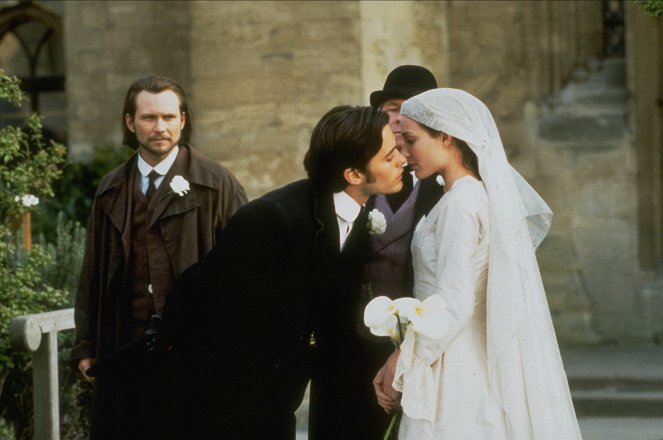
Basil grows up in an upper-class family under the strict authority of Frederick, a father obsessed with social position and family reputation.
From an early age, Basil is made to understand that there are rules governing who he can associate with and whom he can love. Frederick is equally unforgiving toward his other son, whom he disowns after the young man shows interest in a girl from a lower social class.
His treatment of his family is no less troubling. Frederick is unfaithful to his wife, who dies soon afterward, leaving Basil to grow up in an emotionally restrictive household.
The result is a young man who has been protected from much of the outside world. When Basil reaches the age of 20, he admits that he has never really had a friend before.
That changes when he meets John Mannion, played by Christian Slater.
Basil falls in love — and makes a disastrous decision
Basil quickly becomes fascinated by Julia Sherwin, played by Claire Forlani. She comes from outside the aristocratic world in which Basil was raised, making the relationship deeply uncomfortable for his family.
Despite Julia’s reservations, Basil becomes determined to marry her. His feelings overwhelm his judgment, and he rushes into the relationship while promising her the mansion he expects to inherit.
For Basil, the decision appears to be an act of love. For his father, it is another unforgivable violation of the family’s expectations.
But Basil’s greatest mistake may be trusting John.
The friendship that initially gives Basil a sense of companionship eventually becomes the doorway to betrayal. Basil discovers John and Julia together, triggering a confrontation that escalates into a street fight.
By then, the damage to Basil’s life is already considerable.
Frederick turns against his own son

Frederick learns about Basil’s unconventional marriage and discovers that his son intends to give away the property he is expected to inherit.
He responds by disowning Basil.
Suddenly cut off from the privileged life he has always known, Basil attempts to find work. His efforts are unsuccessful, forcing him to confront a world far removed from his family’s wealth and status.
The experience leaves him searching for answers elsewhere, eventually leading him to his long-lost brother in Yorkshire.
There, Basil comes across a letter from John that finally explains the strange chain of events surrounding his marriage.
The revenge plot finally comes into focus
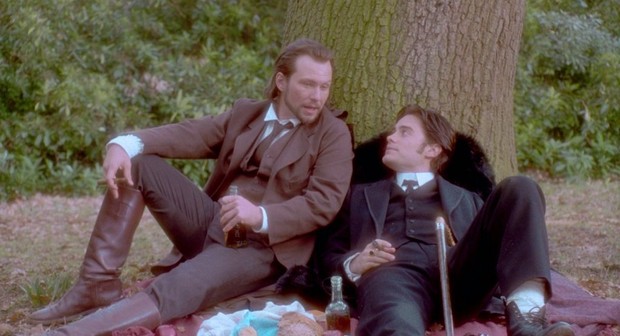
John’s connection to Basil’s family goes much deeper than Basil ever realized.
Years earlier, John’s father had been rejected by Frederick, an event that ultimately led to his death by suicide. John never forgot what had happened.
Instead, he built his life around settling the score with Frederick.
Basil and Julia were not simply caught in a tragic love triangle. John had deliberately positioned himself close to them and used their relationship as part of a much larger plan for revenge.
The revelation transforms everything Basil thought he knew about his closest friend.
What appeared to be an unlikely friendship was actually connected to an old grievance against Basil’s father, while Julia had become a crucial part of John’s scheme.
The film’s central mystery therefore shifts from Basil’s doomed romance to the consequences of a carefully cultivated vendetta.
A period drama with a very mixed reception

For all the intrigue in its story, Basil is far from a universally praised period drama.
The film’s performances can feel exaggerated, with some scenes and dialogue played at a heightened level that may make the characters’ reactions seem less convincing. Its presentation is also unusual. The film was distributed in a 4:3 format, and its editing frequently moves quickly from one scene to another. A later DVD release likewise preserved the 4:3 full-screen presentation.
The movie was also not given a conventional theatrical run in the way many period dramas are. The Wilkie Collins Society notes that it was primarily released on video, with festival screenings and an AMC Romance Classics showing rather than a standard cinema release.
At the same time, contemporary discussion of the production has acknowledged the film’s visual qualities and its ambition as an adaptation of one of Collins’ lesser-known novels.
Difficult characters in a darker Victorian world
The characters are not necessarily easy to sympathize with.
Basil is perhaps the easiest to understand because his awkwardness and sheltered nature are closely connected to the way he was raised. He has spent most of his life under his father’s control and has little experience navigating relationships or the wider world independently.
The women, however, receive considerably less characterization.
Julia is primarily positioned as Basil’s love interest and later becomes central to John’s revenge scheme. Clara serves as Basil’s gentle and supportive childhood friend. Neither is given the same depth of psychological development as the men around them.
That limitation is particularly noticeable because the story reflects the rigid gender expectations of its 19th-century setting. The film includes attitudes toward women that can be uncomfortable for modern audiences, including a line in which John describes Julia primarily in terms of his attraction to her.
Those elements are part of the film’s attempt to portray a society governed by class, gender and rigid social expectations, but they can also make Basil a difficult viewing experience.
A flawed but intriguing adaptation
Ultimately, Basil is an uneven film.
Its performances, pacing and presentation may not place it among the strongest Victorian period dramas, and its characters can sometimes feel more like pieces in a larger plot than fully developed people.
Yet the story itself offers more than a straightforward romance.
Beneath Basil’s sheltered upbringing and ill-fated marriage is a tale about class, parental control, betrayal and revenge. John Mannion’s true motives give the story its most striking turn, transforming what initially appears to be a personal romantic tragedy into the consequence of an old family grievance.
The film remains a relatively obscure adaptation of Wilkie Collins’ Basil, a novel first published in 1852.
For viewers drawn to darker Victorian stories, complicated romances and revenge plots, it may be worth discovering — even if it ultimately falls short of the finest period dramas of its era.