Typography Over Arithmetic: How The 1% Club’s Deceptive “1471” Riddle Exposes the Trap of Overthinking
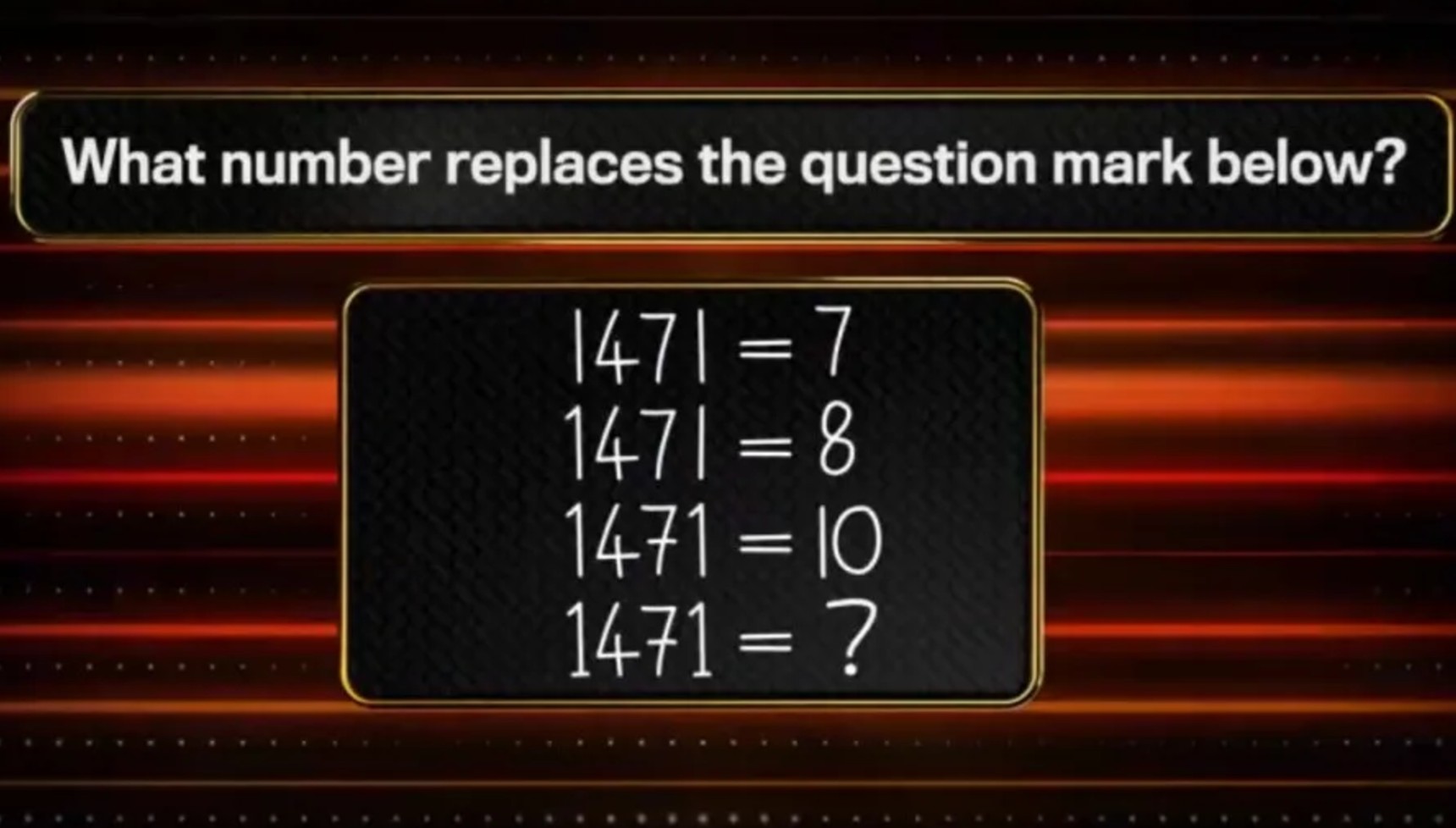
One of the defining formats of ITV’s The 1% Club is the visual misdirection puzzle—a challenge engineered to look like advanced arithmetic while actually testing basic observation. Among the show’s most notorious examples is the “1471” sequence, where contestants frequently spiral into complicated algebra before realizing the numbers are drawings, not equations.
The Challenge: Conflicting Equalities

Players are shown four lines and given 30 seconds to determine the final figure:
The Puzzle:1471 = 71471 = 81471 = 101471 = ?
The Overthinking Trap
Under ticking-clock conditions, contestants instinctively default to standard math operations:
-
Summing the Digits: Adding $1 + 4 + 7 + 1$ yields $13$, which immediately contradicts the first three totals ($7, 8, 10$).
-
Guessing Interval Sequences: Spotting the right-hand numbers ($7 \to 8 \to 10$) tempts players to assume a $+1, +2, +3$ progression and guess $13$, completely guessing the underlying logic.
-
The Cognitive Bias: The brain reads “1471” as a constant quantitative value. In reality, the digits are graphic shapes whose structural composition changes from one row to the next.
The Solution: Counting the Pen Strokes

The number on the right-hand side represents the total count of straight lines (pen strokes) required to illustrate the digits in that specific row:
-
Line 1 ($= 7$):
-
Simple
1: $1$ vertical stroke -
Standard
4: $3$ straight strokes -
Simple
7: $2$ straight strokes (top bar and diagonal) -
Simple
1: $1$ vertical stroke -
Calculation: $1 + 3 + 2 + 1 = \mathbf{7}$
-
-
Line 2 ($= 8$): One digit introduces an extra line (such as a horizontal crossbar through the
7or a top serif on a1), raising the total to $\mathbf{8}$. -
Line 3 ($= 10$): Additional strokes (serifs, base lines, crossbars) are added to the digits, bringing the sum of drawn lines to $\mathbf{10}$.
-
Line 4 ($= ?$): All digits appear in their most elaborate, fully serifed configurations:
-
Both
1s feature a top serif, vertical stem, and bottom base ($3$ strokes each $= 6$). -
The
7features a top bar, diagonal stem, and crossbar ($3$ strokes). -
The
4retains its standard form ($3$ strokes). -
Final Total: $6 + 3 + 3 = \mathbf{12}$
-
Summary of Row Mechanics
| Line | Visual Treatment of “1471” | Stroke Count Breakdown | Output |
| 1 | Bare-bones minimalist digits | $1 + 3 + 2 + 1$ strokes | 7 |
| 2 | Single serif/crossbar modification | $+1$ additional line added | 8 |
| 3 | Multiple serifs and crossbars | $+2$ additional lines added | 10 |
| 4 | Maximum serifs, bases, and crossbars | Fully detailed typography | 12 |